


Everyone

IMG_4965 red.

IMG_4962 red
Women's Empowerment in Earthquake Affected Area
Destiny Roti Kitchens - Corn for Health
Objectives
The Destiny Roti project for making tandoori corn nan or roti was conceived with the following objectives:
a. Further empowerment of women after great success was achieved through the Nokia-Karavan Craft Centres. Women to make extra rotis every day which would be marketed after proper packaging.
b. A methodology to involve the whole household i.e. men and young adults to get the corn ground in the water mills; 12-14 year olds to be involved in carrying the finished roti to the packaging centre.
c. Training and jobs for community in the packaging centre and process of marketing
d. A mechanism to teach women about hygiene and health
e. Promote the special corn flavour special to the area as health food
f. Revitalize damaged water mills because of their key role in giving the corn roti a special grainy flavour, as an attempt to promote indigenous techniques and promotion of alternative water energy to minimize reliance on electric power
g. Encourage the use of tandoor (earth ovens), allowing women to become earning members of their households
Outcome
In a nutshell the achievements are as follows:
a. Pride in tradition and heritage, Sense of Ownership
- Continuance of traditional ways of cooking roti and bringing pride in tradition.
- Promotion of health food special to the area
- A sense of ownership because of their own contribution
b. Sustainable solutions minimizing use of fossil fuel power
- Revitalizing and popularizing water operated grinding mills
- Preference of cooking roti in earth ovens rather than converting to electricity.
- Use of local materials in construction e.g. local stone, local mud, lime etc. minimizing reliance on transportation and cement products which cause greenhouse gases
c. Empowerment of women
- Making it possible for women to earn money within their homes
- Creating an elevated status for women in their family and community
d. Health and Hygiene
Emphasis on keeping kitchens clean for cleaner product; hand washing regimen, washing of utensils etc. to improve health of entire household, particularly children
e. Self-reliance and rising from apathy after the earthquake
By contributing 25% towards cost of kitchen, women have shown self reliance and are no longer apathetic towards their condition.
d. Adult Education
Adult Education has been initiated through the only woman who has graduated from class V. 6 women have joined the classes to read and write. The classes are being held in the Kodar Primary School which has been constructed under the programme.
Key Components
The following are the key components of the project:
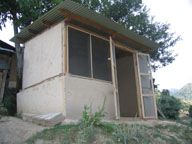
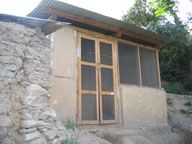
a. Construction of 50 kitchens (with 25% contribution by the households) and 50% grant by I-Led. Thus, the remaining costs of the kitchens along with administrative and transportation costs are being borne by the Nokia-NSN-Karavan project. The contribution by households was considered crucial in developing a sense of ownership and subsequent maintenance of the facility.
b. Value addition to local farm produce.
c. Construction of a packaging centre for vacuum packing and sterilization of the product.
d. Use of local materials and local construction technique to popularize traditional techniques (being given up by communities in the wake of insistence on cement blocks/cement concrete and steel reinforcing bars), thus minimizing generation of green house gases
e. Establishment of a chain for marketing – Suzuki van to transport corn roti to cities in cold storage chambers.
Initial Difficulties
The programme had many initial difficulties. The fact that we had insisted on 25% contribution by households appeared a big stumbling block since the EQ-affected population have got used to receiving free goods. We started by selecting 10 women’s names in order to start 10 kitchens. As the work has been completed and the results are seen by the community, there has been a great demand to build more. Now we have names of all 50 beneficiaries. In fact now there is a rising demand from the surrounding villages of Aahl and Bagno to start a programme of kitchens there as well.
Since we are using wood in construction, difficulties were faced in getting wood at a reasonable price.
There were problems with the kind of steel plate that could be used around the tandoor (earth ovens) which could be cleaned. Initially we had planned to have standardized earth ovens and the plates could be moulded accordingly. However, the site conditions did not allow.
When tandoors were manufactured to a uniform size and supplied to the site, the women were not happy with the tandoors made by other potters, and wanted to have control over the kind of tandoor they wanted. The tandoors that arrived individually were all of different sizes. It was therefore decided to have each steel plate manufactured to fit around the tandoor opening.
Another problem that had not been anticipated was that the steel plate would become very hot and the households wanted that the plate should only be placed once the tandoor had been heated up and roti would be made. This would also help in keeping the steel sheet always clean. The sheets have been manufactured individually to fit the tandoor and are kept movable in order that they could be put away after the roti has been cooked.
Another issue that rose was related to storage of water which should always be clean. The universal choice is to use fiberglass storage tank. But these did not fit in our philosophy to minimize use of new materials which require use of energy for production. Accordingly, clay storage tanks are now being utilized, which are filled directly from the water supply. The storage of water is an important component since it inhibits carrying water in open containers from the source. In case, after testing it is found that the water through the water supply is not up to the standard required, water can be treated in the clay storage tank.
Sale of Tandoori Corn Nan
The soft launch of the programme is expected within the next couple of months. In the meantime preparations are being made to conduct hygiene workshops for participants.

S3010146 red 4

IMG_4322 red

IMG_4310 red

IMG_4308 red

Alexandra London launch red
Book launched for Chelsea Pensioners Fund
Paradise Found: Journeys Through Noble Gardens of Asia -- Book launched to raise funds for the Chelsea Pensioners Fund
HRH Princess Alexandra and Marquess of Salisbury discussing the Nokia-NSN-Karavan Women's Craft project in
area affected by the Earthquake 2005 in Northern Pakistan.
HH Princess Tunku Soraya Dakhlah of Malaysia had telephoned me last year to ask me to contribute towards a book that she was putting together on 100 best gardens of Asia. The book was being published to raise funds for the Chelsea Pensioners Fund for construction of facilities for them. I felt it was a great privilege to be asked to write for the forthcoming publication to which world renowned experts were contributing. It seemed an interesting venture, where contributors from Asia would help raise funds for a charity in the UK, at the same time present the gardens in their own country to a wider public.
But I was already working on two books, one on the Government House, Lahore and another, a coffee table book on Lahore, based on my Lahore Guidebook published some years ago and I seemed perpetually short of time. I had also been quite busy with the work with communities affected by the 2005 Earthquake in Northern Pakistan and had felt that I could not devote time to writing on another topic for which I would have to carry out time consuming research.
But Soraya was extremely persuasive and said she could give me more time if I needed in order that the piece could be completed. I had the choice of two gardens, the Hiran Minar at Shaikhupura and the Wah Gardens at Wah. I finally picked the HIran Minar for writing my piece.
In February I received an email informing that the launch of the book had been set for May 2008 by HRH Princess Alexandra and would my husband, Suhail Zaheer Lari, a noted historian, would like to attend it in the State Apartments at the Royal Chelsea Hospital, London, when a private showing of the Chelsea Flower Show would also be held.
Since Suhail and I both had to carry out research at the British Library, we decided to coordinate the dates so that we could attend this interesting event, at the same time, would be able to carry out research for our books. It was thus that we arrived on 16th of May in London.
We arrived at the Royal Chelsea Hospital and found our way to the State Apartments. The Apartments were part of the building built by Christopher Wren, the architect of the St. Paul’s Cathedral, and visiting the Renaissance building was an exciting experience in itself.
We arrived at the reception where drinks were being served and the completed book was on display. Soraya and her colleagues had done extraordinary amount of work in bringing out a remarkable publication. There seemed to be a select gathering of authors and sponsors. It was wonderful meeting Soraya and her husband Shariff. While Soraya is herself an author, her husband is a film producer. Soraya had been very interested in our work in the earthquake area and the four of us had a good discussion regarding the conditions there. They both promised that they would try and make it to Pakistan, which would be great!
After the reception the launching was carried out in an adjacent Hall, on the walls of which hung enormous oil portraits of various monarchs and those associated with the royal hospital including one of Christopher Wren.
We were introduced to the Marquess of Salisbury who turned out to be a very interesting person. He had been to Pakistan when his son was serving in Afghanistan and seemed to know a great deal about the country. He discussed with me at great length the situation in the earthquake area. As we were talking HRH Princess Alexandra moved towards us and the Marquess introduced me to the Princess. She had also been to Pakistan. I was keen to know if she had stayed at the Governor House in Lahore because then I could get her impressions and perhaps use them in the book I am writing on the Governor House. Alas, she had only been to the Rawalpindi State Guest House, also a historic building. She also wanted to know about our work in the earthquake area. I told her about the bead work of the women and showed the bead bracelet I wear. She said, oh, but this is beautiful. Would you like one Mam, I said. And, from I produced a bracelet and its pouch from my handbag. The Marquess was quite surprised. “Do you always carry these with you”. Yes, these are part of my PR pitch for the women of the area. How do you put it on, the Princess wanted to know, Shall I put it on for you? Yes please, she said. And as I struggled to put it on her wrist, the Marquess said, Mam there is a whole queue waiting to be introduced to you. Oh, It is ok, she said, I have enough time, let me put this bracelet on.
Unfortunately, Suhail had been caught up with a conservative Member of the Parliament and was not able to extricate himself to take a photograph of Princess Alexandra with the bracelet.
Suhail had also been talking to another Member of the British Parliament, Michael Curzon, the great grandson of Lord Curzon, viceroy to India from 1899-1905. I have always had a soft spot for Curzon, and I told the young MP, Viceroy Curzon did much to establish the Archaeological Survey of India, because of which so many of the historic sites were protected.
I was wearing my Sitara-i-Imtiaz award and many people asked me what it signified, one going so far as to ask me to tell him what were my accomplishments which merited the award.
After the speeches and launching of the book we were lead to the Chelsea Flower Show, which was being held in the grounds. It was wonderful to see how well organized the show was and the array of well arranged flower stalls and related products.
We had been there for three hours and for almost all the time, everybody stood and talked. By the end of it we were thoroughly exhausted and glad to make our way back to our hotel, we had chosen because of its proximity to the British Library in King’s Cross, London. Suhail and I spent next many days poring over antique material in the British Library for researching our books, before Suhail made his way back to Karachi and I went to visit our children in the US.